

1. Current Situation and Challenges in Energy Transition in ASEAN 2025
1.1 Current Motorcycle Transport in ASEAN
According to the Asian Development Bank Report published in early 2025, ASEAN is the region with the highest motorcycle density in Southeast Asia, with nearly 250 million motorcycles and light vehicles, accounting for about 80% of all vehicles.
Data from Abeam Consulting (2019) also showed that before the COVID-19 pandemic, the number of registered motorcycles in the region was already very large, including:
- 106 million in Indonesia
- 62 million in Việt Nam.
- 21 million in and.
With this huge number of motorcycles, CO₂ emissions in ASEAN are alarming and have a serious impact on the environment. On average, a small motorcycle emits about 0.08 – 0.11 kg of CO₂ per kilometer.
| Type of fuel | kg of CO2e, per litre | kg of CO2e, per imperial gallon (UK & CA) | kg of CO2e, per US gallon |
| Petrol / Gas | 2.1602kg | 9.8204kg | 8.1772kg |
Method for Calculating CO₂ Emissions of Motorcycles, According to Thrust Carbon
Example: If you fill up a 3-liter gas tank, the CO₂e emissions of a motorcycle will be 6.48 kg CO₂e. When multiplied by hundreds of millions of motorcycles on the road every day, the total emissions from motorcycles in ASEAN cities become enormous, creating serious pressure on air quality and public health.
This shows that the region cannot continue to depend on gasoline motorcycles, and the shift to clean vehicles such as electric motorcycles is becoming more urgent.

1.2 Challenges in Switching to Electric Motorcycles in ASEAN
However, the transition to electric motorcycles is not easy. ASEAN countries are facing many big challenges:
- Lack of charging and swapping infrastructure: The current system for electric motorcycles is far from meeting the scale of hundreds of millions of vehicles in the region.
- Pressure on the power grid: If tens of millions of motorcycles charge directly, city grids will face heavy loads, increasing the risk of overload and imbalance during peak hours.
- Battery recycling and waste management: ASEAN countries still lack proper collection and recycling systems, creating risks of new hazardous waste.
- Cost and consumer habits: Electric motorcycles are more expensive than gasoline ones, and many people prefer quick refueling over waiting hours for charging.
- Performance limitations: Many popular e – motorcycles reach only 60 – 80 km/h, while gasoline models can reach 100–120 km/h, raising concerns about convenience.
In addition, the transition in rural areas is even harder. According to the report “Barriers to Electric Vehicle Adoption in ASEAN Emerging Economies” (2025), countries such as Myanmar still face unstable power grids, making electric motorcycle use almost impossible.
If ASEAN relies only on current approaches, the transition to electric motorcycles will not achieve long-term results. What the region needs now is a new, practical ecosystem to accelerate sustainable transport development.
2. Sustainable Transport Platform: Electric Motorcycle and Battery Swapping Supports Green Mobility Transition
2.1 What is the Electric Motorcycle and Battery Swapping Platform?
The Electric Motorcycle and Battery Swapping Platform is a sustainable transport ecosystem, designed to replace the traditional gasoline motorcycle model. This ecosystem includes not only electric motorcycles but also smart batteries, battery swapping stations, and a connected data management platform.
The key difference of this model is that it creates a synchronized chain from vehicle – energy – infrastructure – data, making electric motorcycles more convenient for riders and easier for cities to deploy.
2.2 Core Sustainable Transport Technology in the Electric Motorcycle and Battery Swapping Platform
- Smart Electric Motorcycles: Fully electric vehicles with a top speed of around 100 km/h and acceleration from 0 – 50 km/h in 3.6 seconds

The motorcycle is equipped with ABS and TCS, offering a riding experience similar to a 125cc gasoline bike but with zero emission - Smart Removable Battery: Designed to be detachable, allowing users to easily swap batteries at stations when energy runs out.


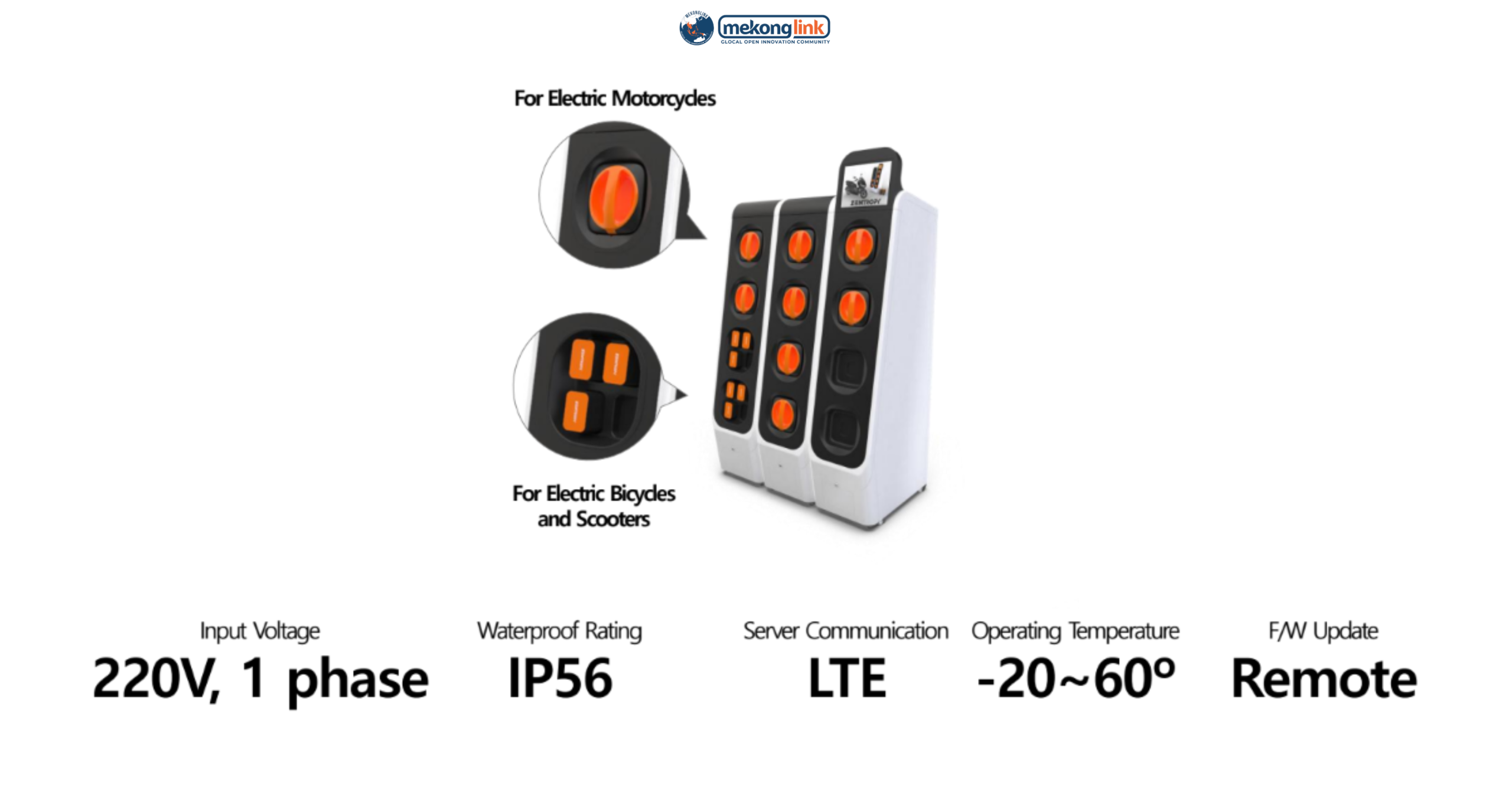
- Battery Swapping Station (BSS): This is the energy infrastructure for electric motorcycle users, allowing them to swap an empty battery for a full one in just 20 – 30 seconds.
- Electric Vehicle Management Platform (IoT + Big Data): The app collects and transmits data every 2 seconds, allowing real-time monitoring of operating conditions.
3. Key Strengths of the Electric Motorcycle and Battery Swapping Platform
- 44 Patents (20 Granted): This ecosystem is protected with 44 patents, including 20 already granted. This proves its exclusive technology advantage, reduces the risk of copying, and builds a strong foundation for technology protection.

Technology Protection with 44 Patents - Smart Removable Battery: The battery is designed to stay under 45°C even when the motorcycle runs continuously at 100 km/h in 35°C outdoor conditions. This reduces fire risks and extends battery life, one of the biggest concerns with electric vehicles.

Real test in Yangsan, Gyeongnam (05/07) with outdoor temperature 35°C: the battery stayed under 45°C while running continuously at 100 km/h. - Cell – Level Battery Monitoring: The battery management system tracks each cell’s data in real time, detects abnormalities, and sends early alerts. This allows users and operators to respond quickly, reducing risks of damage and improving safety.
- 20 – Second Battery Swapping Technology: Users need only about 20 seconds to replace an empty battery with a full one, instead of waiting hours for charging. This directly solves the biggest barrier for EV users – charging time inconvenience.


5. Development Potential from Mobile Energy Storage (ESS) Technology
5.1 Huge Potential in the ASEAN Market
To respond to climate change and worsening air pollution, many ASEAN countries have introduced stricter emission policies and sustainable transport (EV) development. Examples include:
- Vietnam: Hanoi and Ho Chi Minh City announced roadmaps to restrict gasoline motorcycles in city centers and expand Low Emission Zones (LEZ).
- Thailand: The government launched EV 3.0 – EV 3.5 packages requiring automakers not only to import but also to produce locally. From 2025, domestic production must exceed imports.
These actions show that ASEAN is not only expanding the EV market but also pushing for deeper research and development to build a strong foundation for sustainable transport in the region.
5.2 Opportunities for Research and Development
In the journey toward sustainable transport, EV research and development play a key role in solving environmental challenges and creating new economic growth drivers.
- Smart Removable Batteries: This technology solves the problem of long charging time, allowing users to swap batteries in 20–30 seconds. Research on high-capacity, safe, and recyclable batteries also opens the door for a local battery industry, reducing environmental pressure and supporting sustainable transport with long-term economic benefits
- Made in ASEAN Electric Vehicles: Technology transfer and cooperation will help ASEAN countries gradually produce their own EVs. This creates local brands, strengthens competitiveness in global markets, and accelerates the region’s shift toward sustainable transport.
- Data Management Platforms: Connecting motorcycles, batteries, and swapping stations enables real-time monitoring, early fault detection, and optimized maintenance. Businesses save operating costs while gaining new revenue from digital services such as fleet management, data analytics, and smart insurance, all contributing to smarter and more sustainable transport systems.
ASEAN faces big emission challenges from motorcycles, but it also holds great opportunities for transformation. The Electric Motorcycle and Battery Swapping Platform not only addresses current limitations but also drives research, local production, and technology development.
If you are interested in testing and applying this EV technology, don’t hesitate to contact us. Mekonglink always welcomes partners to co-develop sustainable transport solutions in ASEAN.
_________________________________________________

- ☎️ Contact information:
- Email: Community@mekonglink.asia
- International phone: (+84) 02888868685
- LINE: https://line.me/R/ti/p/@702dyrqh


Responses