
1. Problem to be solved: HVAC costs and the need for an Automated Energy Management System in Vietnam
Electricity costs for HVAC are a major burden in the operation of office buildings, commercial centers, hotels, and factories in Vietnam.
- In the context where electricity consumption by cooling systems accounts for about 16-20% of total global electricity and is expected to reach up to 30% by 2030.
- Specifically in agencies and hotels, electricity consumption for air conditioning often accounts for 40-60% (Dr. Nguyen Xuan Tien, 2024).
- Additionally, the characteristic hot and humid climate forces air conditioning systems to operate continuously, increasing the risk of electricity waste if not well controlled.
In actual operation, the common management model still relies heavily on manual settings or the experience of technical teams, making it difficult to maintain operational consistency. Meanwhile, the HVAC market size in Vietnam is growing at a CAGR of 5.25% from 2023-2029 and is projected to reach 1.066 billion USD by 2029 (BlueWeave Consulting, 2023). The air conditioning industry alone is growing faster, achieving a CAGR of 7.82%. The industrial HVAC market demand size also grew at a compound rate of 17% from 2019-2023 (Construction Magazine).
The lack of centralized operational data and transparent reporting makes it difficult for businesses to control electricity costs by area and over time. This makes it challenging to assess optimal efficiency and meet energy saving and ESG reporting requirements for management. Meanwhile, according to Directive 20/CT-TTg, which aims to save 7–10% of energy by 2025 and reduce electricity by at least 2% annually, businesses are under additional pressure to improve the efficiency of HVAC system management.

2. Overview of HVAC management solutions and Automated Energy Management System
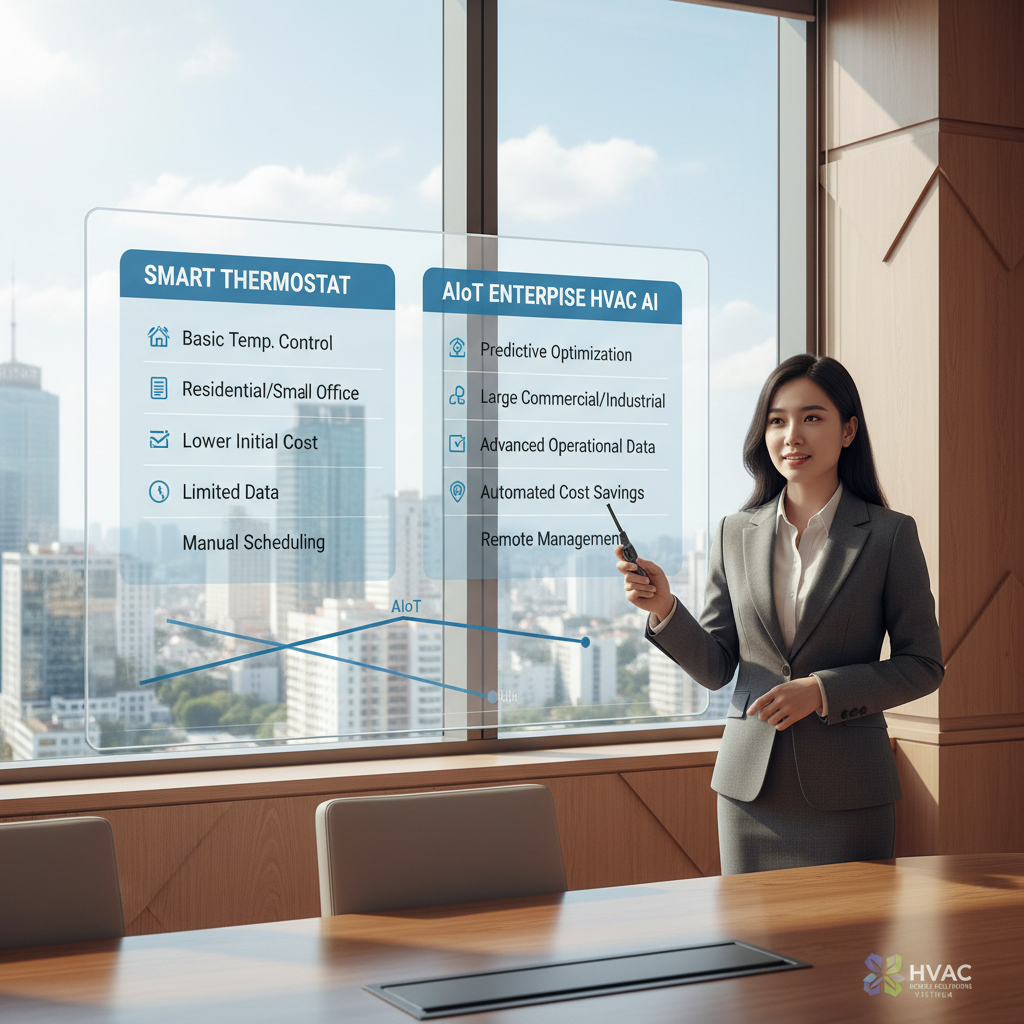
A Smart Thermostat is a device that adjusts temperature, focusing on small spaces, such as single rooms, apartments, or limited-scale offices. Personalized settings or fixed schedules allow for optimizing consumption according to specific needs in each area. The difference in scale and level of automation is clear when compared to systems operating based on AI and IoT.
AIoT-based HVAC AI (Automated Energy Management System) is a solution for businesses with multiple areas or locations. The highlight of this system is its ability to collect data from IoT sensors on temperature, humidity, and operating parameters in real-time, while integrating AI to analyze, predict, and proactively adjust the HVAC system based on environmental fluctuations.
Many studies have proven that applying AIoT to energy management helps optimize HVAC operation and significantly reduce energy consumption.
- According to KPMG in 2025, SEM models applying AI and IoT can reduce energy consumption in commercial buildings by up to 30%.
- Additionally, McKinsey’s report also notes that AI can reduce operating costs by up to 10% and increase system efficiency by 5% to 10%.
- When integrating AI into enterprise energy management systems, continuous monitoring and adjustment capabilities help reduce waste at the building scale, improving operational efficiency.
Evidently, both solution approaches aim for efficient energy use in the work environment, but the main difference lies in the scale of application and the underlying management technology. Smart Thermostats are suitable for localized control of individual rooms, while AIoT-based Enterprise HVAC AI addresses overall operation and energy optimization for businesses with multiple spaces.

3. Detailed comparison of Smart Thermostat and Automated Energy Management System (AIoT HVAC AI)
3.1 Energy efficiency
- Smart thermostats offer energy savings primarily based on manual setup and fixed schedules. With an average saving of 10-12% for heating, and 15% for cooling. This translates to an approximate reduction in energy bills of 131-145 USD per year (The Furnace Outlet & Mordor Intelligence, 2024-2025)
- Meanwhile, AIoT-based Enterprise HVAC AI systems operate by collecting data and integrating motion sensors to automatically analyze usage behavior in each real area, quickly predict demand, and adjust the HVAC system in real-time. The energy efficiency from this solution surpasses traditional fixed schedules due to its ability to proactively change based on observed data.
3.2 Ease of use and deployment
- Smart thermostats are known for their intuitive interface, easy installation, and operation suitable for small spaces.
- Conversely, AIoT-based Enterprise HVAC AI solutions are geared towards large enterprise environments, typically requiring specialized technical teams for system deployment, configuration, and operation.
3.3 Investment cost and long-term effectiveness
- The smart thermostat market tends to grow strongly due to low investment costs, making it particularly suitable for households or small businesses.
- Meanwhile, AIoT-based Enterprise HVAC AI systems have higher initial investment capital but achieve significant long-term energy saving efficiency, especially for organizations needing to coordinate and manage multiple large spaces at the enterprise level.
3.4 System maintenance and operation
- Typically, smart thermostats require minimal maintenance due to their design focused on simplicity.
- Conversely, integrated AI systems often come with periodic maintenance procedures, while also using sensor data analysis (such as vibration, temperature, current) to detect problems early, helping to reduce system downtime by up to 40%. Additionally, AI-integrated BMS optimizes maintenance, extending the lifespan of equipment systems for large buildings.
3.5 Suitability for the Vietnamese market
- Smart thermostats are reasonable for the needs of households and small-scale offices, which prioritize cost and simplicity.
- Meanwhile, AIoT-based Enterprise HVAC AI systems allow for optimized operation of commercial buildings, hotels, factories, or multi-branch businesses, effectively meeting temperature adjustment and energy saving needs in Vietnam’s specific hot and humid climate.

4. Practical applications and test results of Automated Energy Management System in HVAC
Air conditioning is a major factor in total energy consumption in commercial and industrial buildings in Vietnam. According to Dr. Nguyen Xuan Tien, electricity consumption for air conditioning accounts for about 40-60% of total electricity in agencies and hotels nationwide.
Overall, the construction industry, especially in urban areas, uses about 35-40% of the total electricity consumption across the entire locality. Among these, office buildings have the highest energy usage intensity.
In this context, trials applying modern technologies and solutions to HVAC systems have shown clear practical results in energy saving and emission reduction. A pilot project in Dubai with Eurovent certified air conditioning recorded energy savings of up to 64%, while also reducing 78,000 tons of CO₂ emissions. Eurovent’s research also showed that certified cooling towers operating at optimal capacity can save at least 6% energy compared to non-standard equipment; in the long run, this difference causes significant losses in operating costs.
In the domestic market, the application of green HVAC technology based on smart devices, various sensors, and automatic control systems is recognized as a factor helping businesses save energy and operating costs in the long term. These results reflect the role of technological solutions in optimizing resources and meeting increasingly stringent environmental standards for businesses today.

It can be seen that Smart Thermostats are suitable for small spaces with simple operational needs. However, as building scale and the number of areas increase, this solution struggles to meet the requirements for centralized management and long-term cost optimization. In the context of increasing electricity cost pressure and ESG, implementing an automated energy management system that helps businesses manage HVAC based on data rather than experience is a strategic step, thereby supporting more effective and sustainable operational decisions.
👉 Contact Mekonglink today to start saving HVAC costs for your entire building.
Learn more about AIoT-based smart temperature management system from Mekonglink here!
————

☎️ Contact information:
1. Email: Community@mekonglink.asia
2. Website: mekonglink.asia
3. International phone: (+84) 02888868685
4. Vietnam phone: (+84) 364689922 (+84) 364689911


Responses