

1. Background: Riverbank erosion is becoming an urgent issue in the Mekong
Countries in the Mekong River basin such as Vietnam, Cambodia, Laos, and Thailand are facing increasingly severe riverbank erosion due to climate change, changes in flow – sediment, and human impacts. According to the Mekong River Commission (MRC), the average temperature across the basin has increased by 1.4°C in the past 50 years, while sediment load has significantly decreased, leading to riverbank instability and increased erosion (VietnamPlus).
- Impacts: Economic and social risks: Erosion not only affects infrastructure and agriculture but also threatens community livelihoods. The World Bank (WB) estimates Vietnam could lose up to 15% of its GDP annually by 2050, and about 1 million people are at risk of falling into extreme poverty by 2030 (VietnamFinance).
- Need: Sustainable solutions with verified data: Management agencies need solutions that are sustainable, cost-effective, and environmentally friendly. Due to a low-risk acceptance level, they prioritize solutions that have been proven by long-term real-world data, with case studies and objective measurements. The goal is to ensure system safety, scalability, and minimize risks from unverified solutions.
2. Field trials in Vietnam: Design & Implementation
2.1. Pilot project context

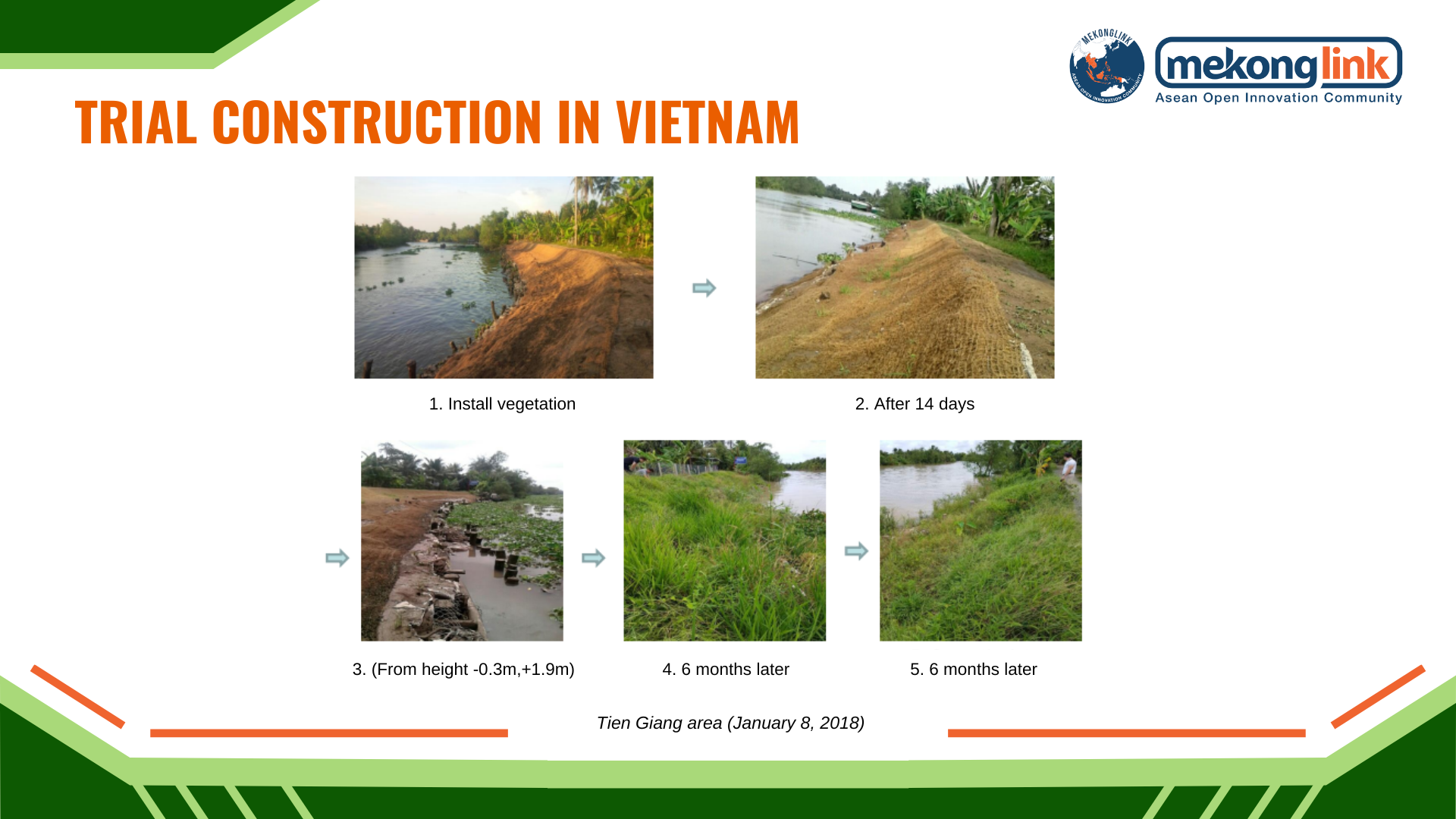
During 2017–2018, field trials were implemented in Dong Thap and Tien Giang (Mekong Delta) – areas with high erosion rates and complex hydrological conditions, representing typical challenges of the Mekong region. The project’s goal was to evaluate the ability of vegetation mats to control riverbank erosion under diverse and harsh natural conditions.
2.2. Implementation & monitoring methods
- Vegetation mats were installed in designated areas, followed by regular monitoring to assess:
- Vegetation mat growth
- Riverbank stability
- Factors monitored included rainfall, water levels, flow, and related environmental conditions, for a comprehensive assessment of resilience and recovery.
>>> see more details about the Vegetation Mat solution here
2.3. Real-world data collection
Data was continuously recorded over several weeks to several months, reflecting the growth rate of vegetation mats and the natural recovery capacity of eroded areas.
3. Results after 6 months: Effectiveness proven by data
3.1. Increased vegetation cover, protecting soil surface
After 6 months, the vegetation cover rate in the pilot areas significantly increased, helping to protect the soil surface from the direct impact of rain and water flow. The increase was measured based on the ratio of covered area compared to the initial state.
3.2. Reduced erosion and stabilized riverbanks
Data showed a clear reduction in soil washout, by comparing topographical indices and sediment volume before and after implementation. The plant root system helps retain soil, contributing to riverbank and slope stability, limiting landslides and deformation.
3.3. Restoration of local ecosystems
In addition to technical effectiveness, vegetation mats also promote the restoration of riparian ecosystems, improving habitats and biodiversity.
3.4. Core value: Long-term data for practical decisions
The results after 12 months provide clear quantitative evidence, meeting the requirements for long-term field data for engineers and management agencies in evaluating and selecting solutions.
4. Insights from practice: Why is this solution reliable?
Actual implementation shows that the decisive factor for trust lies not in theory but in long-term monitoring data under natural conditions. The results record effective riverbank stabilization not only during each rainy season but throughout the river’s dynamic cycle. In addition to technical effectiveness, the solution also helps restore local ecosystems, creating a balance between project efficiency and environmental responsibility (ESG) – something many traditional solutions have not met.
>>> see more details about the Vegetation Mat solution here
5. Significance for management agencies

Case studies in Vietnam bring two core values:
- Reduced decision-making risk: Long-term empirical data provides management agencies with a basis for evaluating and approving projects instead of relying on theoretical models.
- Meeting ESG & transparency standards: Practical evidence becomes the foundation for reporting requirements and sustainable development according to international standards.
6. Conclusion: From trials to scalable solutions
After 12 months, the study provided clear quantitative evidence of the effectiveness of vegetation mats in increasing cover, reducing erosion, and stabilizing riverbanks. This serves as a reliable basis for engineers and policymakers to select sustainable solutions for the Mekong region.
7. Time to scale up application in Vietnam
Erosion control needs to be based on pre- and post-implementation data, continuous monitoring, and multi-factor assessment. This solution not only focuses on technical aspects but also opens opportunities for Vietnamese businesses to actively participate in ESG projects and sustainable infrastructure, while building more practical case studies in the domestic market. As they gradually accumulate implementation experience and field data, businesses can not only enhance their capabilities but also expand throughout the Mekong region. The current case study should be seen as a starting point, not an end point — the more projects implemented, the greater Vietnam’s advantage in leading sustainable solutions in the region.
If you are looking for opportunities to participate in or implement this solution, please fill out the form to connect and start collaborating today HERE
___________________

Contact information:
- Email: Community@mekonglink.asia
- Website: mekonglink.asia
- International phone: (+84) 02888868685
- Vietnam phone: (+84) 364689922 (+84) 364689911


Responses