

1. Current Situation and Challenges in Ensuring Battery Safety
1.1 Current Safety of Electric Vehicle Batteries in ASEAN
In recent years, many fire accidents related to electric vehicle batteries have been reported, showing serious safety risks.
- Vietnam: According to local news, on 7 September 2023 in Nghe An, an electric motorbike that was charging suddenly produced smoke and caught fire inside a house. The owner had to use a fire extinguisher to stop the fire. Fortunately, no one was injured.
- Thailand: Many similar incidents have been recorded:
- Udon Thani, 3 September 2023: A newly purchased BYD Atto 3, less than one week old, started smoking while charging.
- Bangkok, 19 April 2025: A 2024 EV suddenly caught fire while charging early in the morning. No one was injured, but the case raised strong concerns about EV safety.
The common point of these incidents is that they happened when the vehicles were not operating, mainly during charging or while parked. This shows that the risk does not come from the driver but from the battery cells and the electrical system, where hidden faults can trigger “thermal runaway” at any time.

1.2 Challenges in Battery Quality Control
The battery fire incidents in Vietnam and Thailand show a clear reality: the electric vehicle industry is facing big challenges in battery safety.
- Hidden cell defects are hard to detect: Small defects inside battery cells can build up into fire risks, but they often go beyond the detection ability of traditional inspection methods.
- Battery life and quality cannot be predicted: Without accurate analysis data, companies find it hard to forecast battery lifespan and make plans for recycling or warranty.
- Lack of deep analysis tools: Current measurements focus mainly on voltage or charge discharge cycles. These are not enough to show the full internal condition of the battery.
- Pressure to follow international standards: With ESG and Net Zero becoming mandatory, companies must prove their ability to control battery safety under global standards.
2. Battery Cell Diagnostic System – An Advanced Solution for Electric Vehicle Batteries
2.1 What is the Battery Cell Diagnostic System?
The Battery Cell Diagnostic System is a new generation solution for testing and diagnosing batteries. It is developed based on Electrochemical Impedance Spectroscopy (EIS). The system is designed to address three key issues of electric vehicle batteries: fire risk, reduced lifetime, and quality defects.
In other words, it is not only a testing tool but also an “intelligent sensor” that helps companies understand the internal condition of batteries before accidents happen.
2.2 How the Battery Cell Diagnostic System Works
The system uses a high speed impedance measuring device, operated by an automatic XYZ controller, to check cylindrical lithium ion cells.
- First, the battery cell is fixed in place with a special jig.
- The device then moves along the three XYZ axes to perform automatic measurement.
- The measurement is based on Electrochemical Impedance Spectroscopy (EIS), which allows detailed analysis of the internal state of the cell.
- The results are processed through AI analysis software, which provides a quantitative diagnosis of degradation and SOH (State of Health).
- AI also classifies different degradation patterns from EIS data and automatically identifies abnormal cells.
- All data and results are shown on a clear dashboard. The system can be used in many stages: from incoming inspection, production monitoring, to final inspection before shipment.

2.3 Key Advantages of the Battery Cell Diagnostic System
The Battery Cell Diagnostic System shows clear advantages compared to traditional testing methods in four main areas:
- Patents and international certifications: The technology is protected with 29 domestic patents (11 already granted) and 9 international applications (1 U.S. patent granted, 14 PCT filings).
- Ultra fast and accurate testing: It reduces measurement time from minutes or even hours down to only a few seconds. It ensures high accuracy in cell evaluation, suitable for both large scale production and recycling.
- Deep analysis with EIS technology: Electrochemical Impedance Spectroscopy (EIS) is used to analyze the internal condition of electric vehicle batteries in detail.
- Smart prediction with AI and Big Data: EIS data is combined with AI analysis software to classify degradation models and diagnose the State of Health (SOH).

2.4. Real Applications and Achievements of the Battery Cell Diagnostic System
| Battery analysis in Korea (2022) |
– Analyzed CE, NE, and NVH battery types to check quality and estimate battery lifetime. – Applied high speed diagnostic technology to process battery samples with high accuracy. |
| International cooperation project (2024) |
– Tested battery samples from overseas customers, expanding applications beyond the domestic market. – Selected for the “Baby Unicorn” program, showing strong global commercial potential. |
| Application in mass production lines (2024 – 2025) | – Chosen by Hyundai Motors and Glovis for the Zero One program (2025), proving its value in large scale EV production. |
| Technology recognition and awards (2024 – 2025) |
– Won the FIX2024 Innovation Award. – Honored at the InterBattery 2025 Awards, confirming its technology reputation in the global energy sector. |

3. Market Trends and Innovation in Battery Diagnostic Technology in ASEAN
3.1 Market Demand for Safer Electric Vehicle Batteries
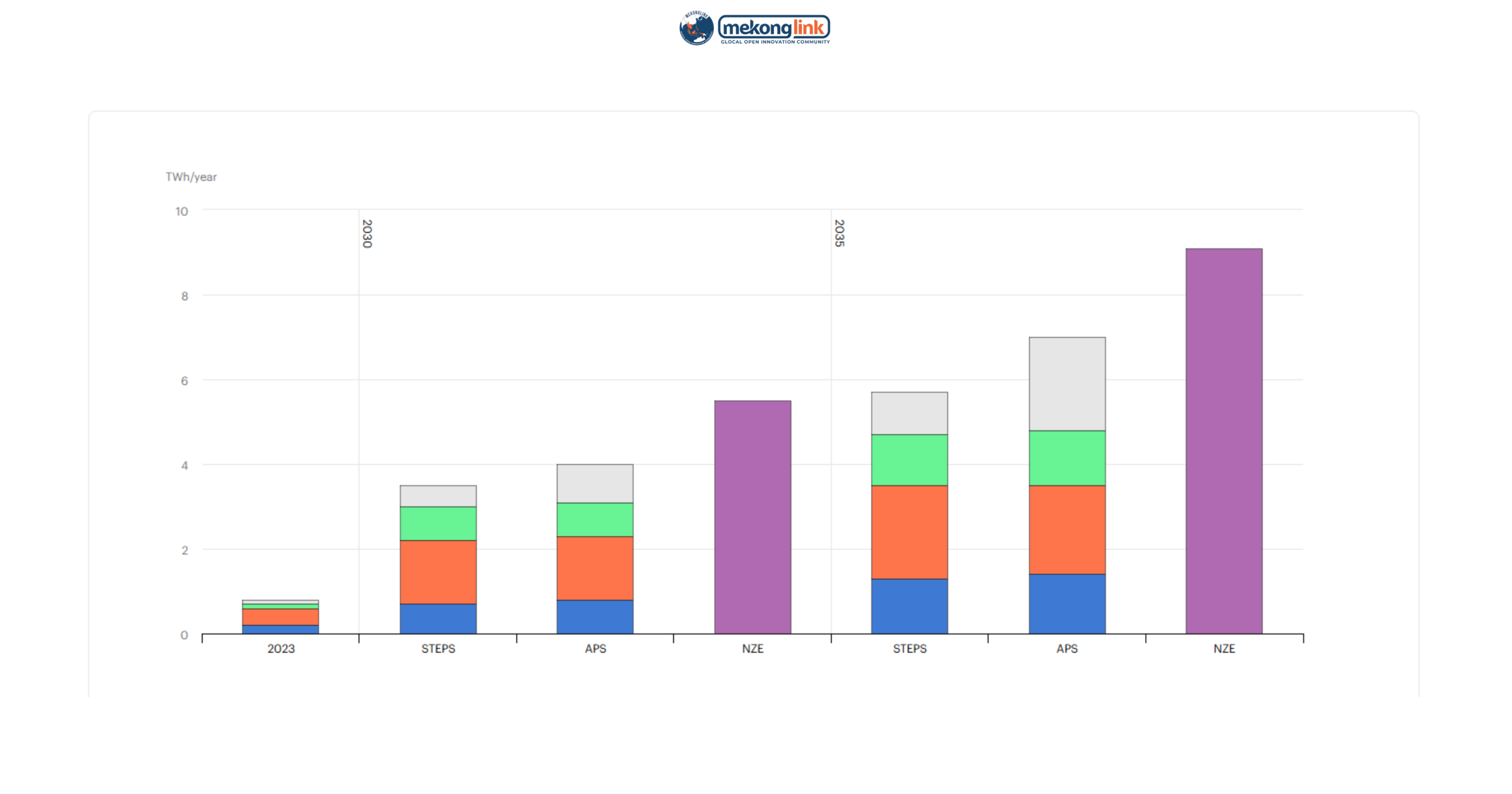
Global demand for electric vehicle batteries is expected to grow five times by 2035. At the same time, BloombergNEF (2024) reports that batteries account for 60 – 70% of the total cost of EV production, meaning every improvement in battery lifetime or safety has a direct impact on the industry’s economic efficiency.
In ASEAN, the recent battery fire accidents in Vietnam and Thailand are a clear warning: rapid growth without advanced diagnostic and research tools can increase safety risks and slow down the whole market.
Therefore, battery research is no longer an option. It has become a key requirement to ensure that the electric vehicle industry develops in a safe and sustainable way.
3.2 Opportunities in Business and Commercialization of Energy Saving Solutions
The boom of electric vehicles and the fire risks of electric vehicle batteries in ASEAN show the urgent need for advanced diagnostic tools. This opens big opportunities for business cooperation.
- Short term: Companies can quickly apply the battery diagnostic system in production lines and after sales services. It can check incoming and outgoing batteries and detect hidden defects. Early commercialization brings competitive advantages, reduces fire risks, and increases product reliability in the market.
- Medium term: Partners can expand the battery diagnostic system into EV service centers across ASEAN, combined with OEM or distribution models. This helps build value added services and supports the trend of battery reuse and recycling driven by ESG and Net Zero policies in the region.
- Long term: A full commercial ecosystem around batteries can be developed, from production, distribution, and maintenance to recycling. The technology can also expand to electric cars, industrial energy storage, and electronic devices, creating a base for long term sustainable growth.
The growth of electric vehicles is opening a new era for the global energy industry. To succeed, the market needs battery diagnostic tools that are accurate, smart, and sustainable. The Battery Cell Diagnostic System is the solution that connects production, recycling, and research, and creates a strong foundation for next generation battery innovation.
If you are interested in developing this solution in the ASEAN market, please contact Mekonglink using the information below for cooperation.
Register today and bring your business closer to a sustainable future here!
_________________________________________________

- ☎️Contact information:
- Email: Community@mekonglink.asia
- International phone: (+84) 02888868685
- Vietnam phone: (+84) 364689922 (+84) 364689911
- LINE: Mekonglink


Responses