
1. Common misunderstandings about market presence in B2B compared to traditional marketing
For many years, a common assumption has existed in B2B companies: if a brand appears often enough in front of the right customers, growth will naturally increase.
This approach used to work when there were fewer communication channels, simpler buying journeys, and limited information choices for buyers. However, in the modern B2B environment, this assumption shows many weaknesses:
- First, being seen does not mean being trusted. Buyers may see a company many times but still not feel confident enough to make a high-risk decision.
- Second, high visibility can create a false sense of security in reports. Visibility numbers may look positive, but they do not directly reflect persuasion power or risk reduction for decision-makers.
- Third, when companies focus too much on spreading information widely, they often lack elements that allow buyers to independently verify what the company says about itself.
The problem with B2B advertising today is not that companies or marketing teams are doing poorly. The real issue is that the market context and decision-making culture have changed deeply. Companies may already be very visible, even more than average, but the way buyers receive information is no longer the same. When information becomes overloaded and skepticism increases, visibility alone no longer turns into trust. This change is the starting point of the growth paradox that many B2B companies are facing.

2. Why does high reach still not create high revenue?
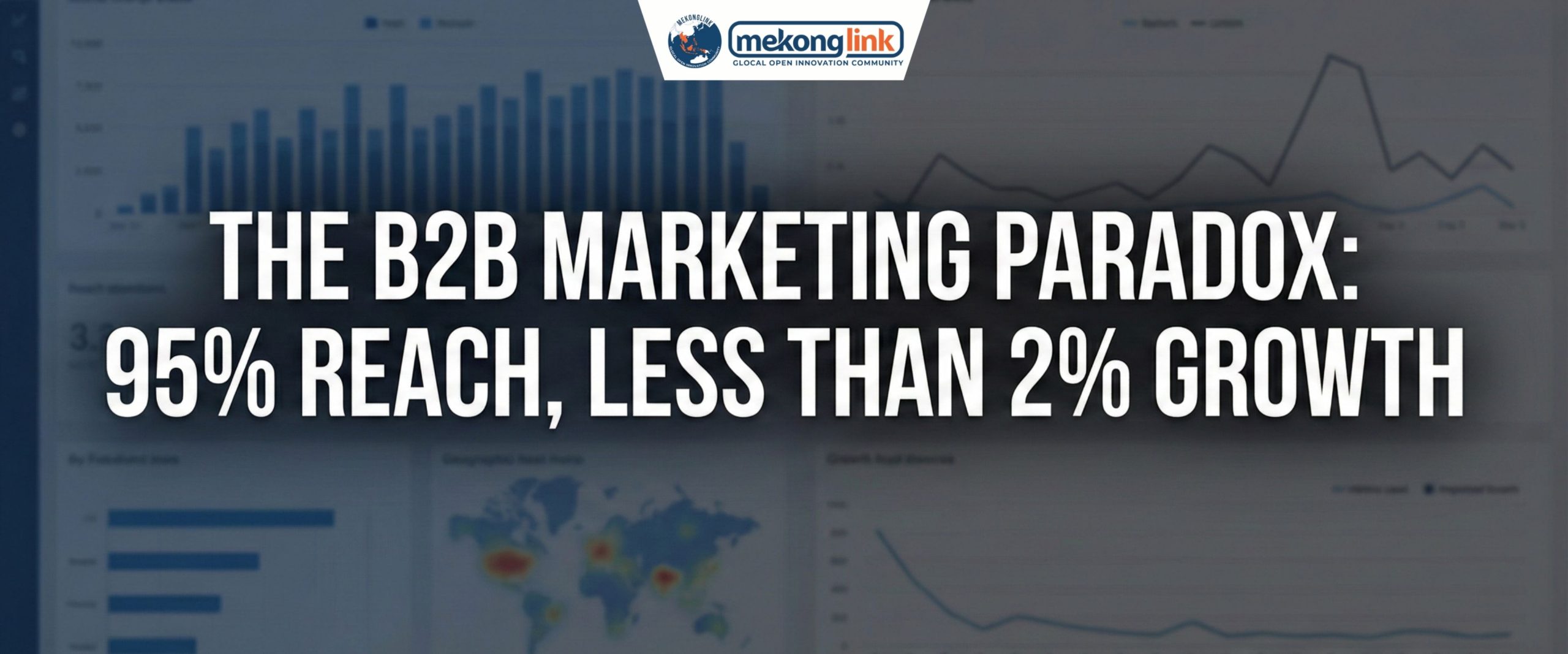
A study by Thomaz, Bell, and Stephen, based on data from 1,083 global advertising campaigns by Kantar, highlights an important reality in modern B2B marketing:
- More than 80% of campaigns reached 95-96% of their target customers
- However, average business growth was still under 2%
In contrast, a very small group of cases – where information was supported by many different verification sources – achieved growth rates of 15-18%. The study also shows that only about 1% of campaigns deliver outstanding results, while most remain at an average level.
The key point of Thomaz’s research is not to deny the importance of reach. Instead, it shows that not all reach has the same value. Reach is a necessary condition, but it is not enough to create business impact if marketing is not designed to influence the decision-making process.
3. From single messages to a B2B purchase verification process
After analyzing more than 1,000,000 customer journeys, Thomaz mapped up to 72 touchpoints that influence decision-making. This shows that B2B purchase decisions do not happen at one moment but result from a long process of contact and evaluation.
In this context, trust is no longer built from a single marketing message, even if that message is repeated many times. Instead, trust is formed when buyers continuously compare information from different sources.
According to the Content Preferences Benchmark Survey 2024 by Demand Gen Report, when entering the evaluation and selection stage, B2B buyers do not prioritize one-way promotional messages. They focus on content that helps verify information and reduce risk, such as case studies, expert-led content, and analysis based on real implementation.

The common point of the most trusted content is the human and experience factor. Buyers trust what others have actually done, tested, and proven in similar situations. Therefore, decisions do not come from hearing one message many times but from seeing the same information confirmed repeatedly by independent sources.
Data shows that the role of traditional marketing in B2B is shifting toward supporting the decision-making process. Buyer trust is not built at a single touchpoint but gradually formed throughout the process of research, comparison, and evaluation.
4. Redefining the Role of Traditional Marketing in the B2B Decision Journey
Analysis shows that traditional marketing still plays an important role, but its current approach no longer aligns with B2B decision-making behavior. When marketing is run as a set of isolated activities, it cannot effectively support a complex, high-risk B2B decision-making process.
In this context, traditional marketing should be seen as part of a broader influence architecture, where each touchpoint has a clear function: creating awareness, providing background information, guiding comparison, and supporting verification. The value of marketing does not lie in individual channels, but in how channels support each other to influence decisions.

From this need, the Trust-as-a-Service (TaaS) model has gradually emerged. Instead of expecting buyers to “trust” marketing messages, this model focuses on providing verifiable proof through people, real implementation experience, and real usage contexts. In this case, trust is no longer a subjective feeling but the result of a structured verification process.
M-Expert is a service designed to operate the Trust-as-a-Service model in real B2B environments. Through a network of industry experts in local markets, M-Expert helps businesses add verification touchpoints that traditional marketing cannot easily create. These include independent expert evaluations, sharing real implementation experience, and analyzing solution fit in specific contexts. This content does not replace marketing activities. Instead, it acts as third-party validation, helping buyers verify information, reduce risk, and feel more confident when making decisions.
👉 Connect with M-Expert here to build a sustainable growth foundation for your business!
_________________________________________________
 Contact information:

- Email: Community@mekonglink.asia
- Website: mekonglink.asia
- International phone: (+84) 02888868685
- Vietnam phone: (+84) 364689922 (+84) 364689911


Responses