
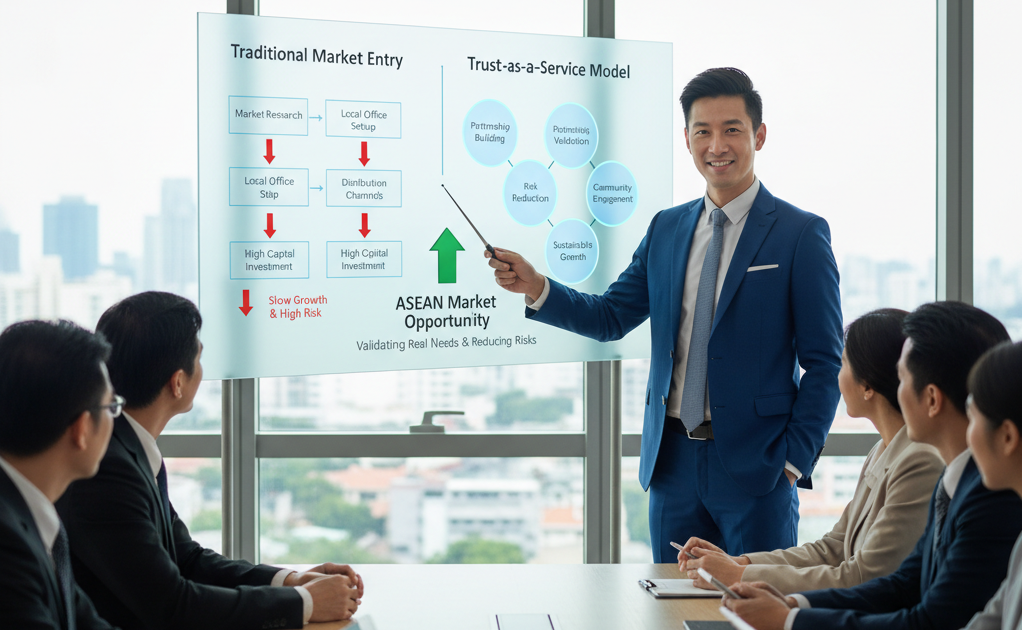
1. How does Trust-as-a-Service differ from traditional market entry strategies?
The outstanding difference of the Trust-as-a-Service model stems from its approach that focuses on building a foundation of trust and validating solution value right from the initial stage, instead of merely emphasizing market access activities like traditional models.
1.1 Validating demand and solution fit before expansion
Instead of merely stopping at market research and initial contacts, the Trust-as-a-Service model heavily focuses on verifying demand and the actual responsiveness of the solution. This process includes organizing real-world testing programs such as pilots or PoCs, through which businesses directly check the compatibility between their product/service and the specific requirements of the target market. As a result, businesses not only identify the existence of demand but also have a basis to assess the depth and suitability under actual conditions, thereby limiting risks arising from impractical evaluations.
1.2 The role of local experts in building trust
The next difference of this model lies in the integration of local experts with deep specialized knowledge and understanding of the cultural, technical, and business context of the target market. While traditional models often rely primarily on existing sales or distribution networks, Trust-as-a-Service places industry-reputable experts at the center of the evaluation and validation phase. These experts not only add an objective element but also help increase the practicality and reliability of the opportunity validation process. This contributes to establishing strong trust among suppliers, buyers, and stakeholders within the business ecosystem.
1.3 Converting potential opportunities into actual revenue
Traditional models often measure success based on the number of signed memorandums of understanding (MOUs) for cooperation, however, not all of them translate into actual revenue. Trust-as-a-Service differs by focusing on converting pre-qualified potential buyers into real customers. This process not only seeks buying intent but also clearly verifies the real demand, financial capability, and long-term cooperation commitment of the buyer. As a result, business development activities are based on trust and transparency regarding the solution’s value in a practical context, rather than solely on written commitments.

2. How the Trust-as-a-Service model operates in practice
The Trust-as-a-Service model is implemented based on a cyclical mechanism, focusing on building and validating trust through specific stages. A key highlight in this model’s operation is the positioning of trust as a continuous value that needs to be established and tested, rather than being assumed through hypotheses or linear roadmaps.
2.1 Establishing trust through an expert network
The core element of the mechanism is using a network of reputable local experts to bridge the gap between international brands and the business community in the target market. These experts are not only responsible for evaluating the technical criteria of the solution but also play a role in transmitting information and enhancing understanding of the solution through training, workshops, or directly addressing business community inquiries.
With a deep understanding of the local context, language, and business specifics, they establish a highly effective communication channel in overcoming language, cultural, or transparency barriers, which are characteristic of emerging markets. This bridging role enhances the reliability of the solution, helping local businesses make decisions based on in-depth data rather than just promotional information.
2.2 Phased market validation process
The validation process of the Trust-as-a-Service model is structured into three main phases and proceeds systematically. First, the initial validation phase focuses on identifying actual demand and testing the basic compatibility of the solution locally. This activity typically involves in-depth interviews, expert surveys, and organizing small-scale specialized workshops to gather objective insights from stakeholders. Next is the Proof of Concept (PoC) testing phase, where the product is applied in a real-world, small-scale setting with a selected group of target customers.
The purpose of this phase is to collect empirical data on operational performance, integration capabilities with existing systems, and direct feedback quality from end-users. Finally, if the feedback from the PoC phase is positive and risk factors have been reasonably adjusted, the model moves to a controlled expansion phase. This is only carried out after technical and practical interaction issues have been addressed, helping to minimize risks during mass deployment in the new market.
2.3 Adjusting Go-To-Market strategies based on real data
At every stage, information and data continuously accumulated from validation and verification activities form a crucial basis for adjusting the Go-To-Market strategy. The Trust-as-a-Service model avoids rigid strategic thinking by organizing a flexible GTM framework that can change according to real feedback. Factors such as product positioning, distribution channel selection, and market approach methods are always reviewed and adjusted to ensure the solution best fits specific needs at each point in time. Continuous adjustment based on real data helps increase the alignment between the product offered and the actual needs of businesses in a market context that is still subject to many fluctuations.

3. Strategic benefits of market expansion using Trust-as-a-Service
Market expansion poses many challenges for brands but also offers core benefits in terms of operations, business, and organizational capacity when this process is carried out based on reliable validation and practical data.
3.1 Reducing operational risks when entering new markets
Brands can minimize resource waste by limiting investment in marketing campaigns or distribution channels that have not been proven effective. Once actual demand is validated, businesses can optimize their implementation process with clearly targeted pilot and PoC activities, thereby collecting specific data to adjust the solution appropriately instead of mass deployment based on assumptions. This also helps enhance the effectiveness of the Go-To-Market strategy, as every product or service launch decision is based on objective data rather than subjective sentiment.
3.2 Increasing conversion rates from opportunities to revenue
Converting from Memorandums of Understanding (MOUs) for cooperation to concrete revenue is often a major challenge when expanding into new markets, but this process is significantly improved if commitments are based on actual needs and initial trust has been built with partners. Furthermore, brands will foster sustainable growth by building trusted relationships with customers and the market right from the outset, laying the groundwork for long-term cooperation instead of merely achieving temporary short-term transactions. A realistic market validation approach also helps brands prevent financial or reputational risks that could arise from large investments in unsuitable environments, protecting the brand’s long-term values.
3.3 Enhancing data-driven decision-making capabilities
During expansion, brands have the opportunity to access reliable market data and information through expert channels, which increases accuracy when assessing the local context, target customer needs, and competitive landscape. As a result, strategic expansion decisions are always based on actual data, minimizing subjective factors in operation. The outcome is that brands not only enhance their market adaptability but also improve their ability to flexibly and appropriately adjust products, services, and business strategies for each specific segment and local market.

4. Real-world evidence for the Trust-as-a-Service model
The effectiveness of the Trust-as-a-Service model is elucidated through real-world test data and evidence from implementations in various countries and large organizations.
4.1 Results from pilot and PoC programs
In many B2B industries such as technology, energy, and industrial manufacturing, pilot and Proof of Concept (PoC) programs are often implemented as an initial validation step before market expansion.
Through small-scale trials, businesses can evaluate operational performance, integration capabilities with existing systems, and user feedback. This data helps determine the fit between the solution and actual market needs, thereby reducing risks during expansion.
Many innovation and public-private partnership programs in ASEAN also adopt this approach, where new technologies are tested under real operating conditions before widespread deployment to ensure technical and economic feasibility.
4.2 Impact on conversion rates and revenue growth
When market demand and solution fit are pre-validated through a pilot or PoC, the conversion rate from business opportunities to actual contracts is often significantly improved. Instead of relying solely on initial cooperation agreements like MOUs, businesses can better assess customer readiness, financial capability, and the actual value of the solution.
This approach helps businesses focus resources on pre-qualified customers, thereby increasing the likelihood of converting into actual revenue and reducing risks when investing in market expansion.
4.3 The role of the local expert ecosystem
A crucial element of the Trust-as-a-Service model is the participation of local experts in the solution validation and market assessment process.
These experts possess practical experience in the industry, understanding the technical context, regulations, and business specifics of each market. When participating in pilot or PoC programs, they can provide an independent evaluation of the solution’s feasibility, while also helping businesses adjust their products and deployment strategies to suit local conditions.
As a result, the market expansion process is not solely based on initial research assumptions but is supported by real data and expert evaluations, increasing the reliability and success rate of the market entry strategy.

5. When should businesses apply Trust-as-a-Service?
The Trust-as-a-Service (TaaS) model is considered suitable for various scenarios when businesses need to expand into new markets and face obstacles related to trust or demand uncertainty.
5.1 B2B industries with long and complex sales cycles
In industries such as information technology, healthcare, energy, or industrial manufacturing, purchasing decisions often involve large investments and extended evaluation processes. Therefore, the factor of trust between parties plays a particularly crucial role.
According to Forrester’s survey, B2B buyers with high trust in a supplier are likely to recommend that supplier to others or are willing to pay more than twice the price compared to when there is no trust. Integrating local experts into the TaaS model helps increase the reliability of the solution evaluation process and supports building long-term collaborative relationships.
5.2 Emerging markets with cultural and regulatory barriers
In emerging markets like ASEAN, businesses often encounter numerous challenges related to language, business culture, and legal systems. These factors can significantly limit traditional market entry strategies.
The TaaS model addresses this issue by integrating local knowledge through an expert network, helping businesses adjust their product strategies, services, and market approach more appropriately. Forrester’s research shows that expertise, consistency, and reliability are decisive factors for B2B buyer trust in the decision-making process.
5.3 Businesses need to control initial investment risks
When entering a new market, businesses often face financial risks if they make large-scale investments from the outset. The TaaS model allows for the implementation of pilot or PoC trial projects on a small scale, helping businesses collect real data on demand and operational capabilities before expanding.
This approach helps minimize investment risks and creates a clear database for adjusting the Go-To-Market strategy.
5.4 New technologies require market education time
For new technology solutions, local markets often lack sufficient awareness of the product’s value. In this case, the TaaS model utilizes industry experts and specialized activities such as workshops, technical evaluations, or real-world trials to help customers better understand the solution’s benefits.
According to Forrester’s research, in complex B2B transactions, buyers are willing to pay a higher price or recommend the supplier to other partners when they have sufficient trust in the solution.

Expanding into the ASEAN market is not just about customer acquisition; it’s also about building trust. Traditional market entry strategies often focus on market research and initial cooperation agreements but lack mechanisms for validating demand and solution fit under real-world conditions.
Trust-as-a-Service offers a different approach: market validation through pilots, PoCs, and the participation of local experts. When trust is built upon real data and experience, businesses not only minimize risks when expanding into new markets but also increase their ability to convert potential opportunities into sustainable revenue.
👉 Discover how Trust-as-a-Service helps reduce risks and build sustainable growth when expanding into new markets.
Connect with M-Expert now to learn about suitable Go-To-Market strategies in ASEAN here!
————————-

☎️ Contact information:
1. Email: Community@mekonglink.asia
2. Website: mekonglink.asia
3. International phone: (+84) 02888868685
4. Vietnam phone: (+84) 364689922 (+84) 364689911


Responses