

1. Landslides increase in many countries and the urgent need for early disaster prevention measures
Landslides are becoming an increasingly serious environmental risk in many countries, especially in tropical and subtropical regions. Countries such as India, the Philippines, Indonesia, Malaysia, Thailand, and Vietnam all record an increasing trend in the frequency and impact of landslides, due to steep terrain, dense river systems, and heavy seasonal rainfall.
In Vietnam, this pressure is clearly demonstrated by the need to relocate and protect communities. By 2025, approximately 6,000 households in 24 provinces and cities are classified for urgent relocation due to high landslide risk. Besides natural factors, activities such as urbanization, resource exploitation, and changes in water flow also increase the risk of soil instability, especially in riverside and mountainous areas.
In this context, businesses, investors, and public authorities need to clearly recognize the urgency of proactive response. Experience shows that recovery costs are often many times higher than the costs of actively preventing natural disaster risks.
Ensuring environmental, social, and governance standards has become a decisive factor in building long-term development strategies, especially as requirements for effective, sustainable response solutions are becoming increasingly stringent and closely related to the ability to access international capital and enhance organizational reputation within the community.

2. Actual landslides show the urgent need for new prevention solutions
Actual landslide and soil erosion incidents show that this risk does not come from a single cause. It is the result of many combined factors, including terrain, prolonged heavy rainfall, and human impact.
- In the Philippines, in 2003 in Southern Leyte, a serious landslide occurred after many days of heavy rain in a hilly area. Over 200 people died. This event shows that areas with weak geology and lack of vegetation cover are very prone to instability when encountering extreme weather conditions.
- In Vietnam, the landslide in Tra Leng (Quang Nam) in 2020 is also a typical example. Prolonged heavy rain combined with complex terrain caused a large-scale landslide, resulting in serious losses of life and property. This case highlights limitations in planning and early warning, especially in high-risk areas.
- Additionally, in coastal and riverside areas like Binh Thuan, erosion occurs frequently. Agricultural land is gradually lost, and coastal infrastructure is directly affected. This has long-term impacts on the livelihoods of local residents.
The above examples show that landslides and erosion are no longer potential risks but have become actual problems. Relying solely on traditional measures or post-incident solutions is insufficient. Instead, preventive solutions are needed that are suitable for natural conditions and capable of long-term adaptation.
3. Why is vegetation mat an effective solution for slope stabilization?
Actual landslide incidents show a common point: many current solutions only address consequences, failing to tackle the root cause of surface instability and lack of protective cover. Therefore, the current need is not just for quick reinforcement, but for building a long-term stabilization mechanism suitable for natural conditions.
In this context, vegetation mat (Vegetation Mat) is considered a suitable solution due to its ability to combine engineering and biology. This solution creates a protective layer directly on the slope surface, while supporting vegetation growth to maintain stability over time, rather than relying entirely on rigid structures.
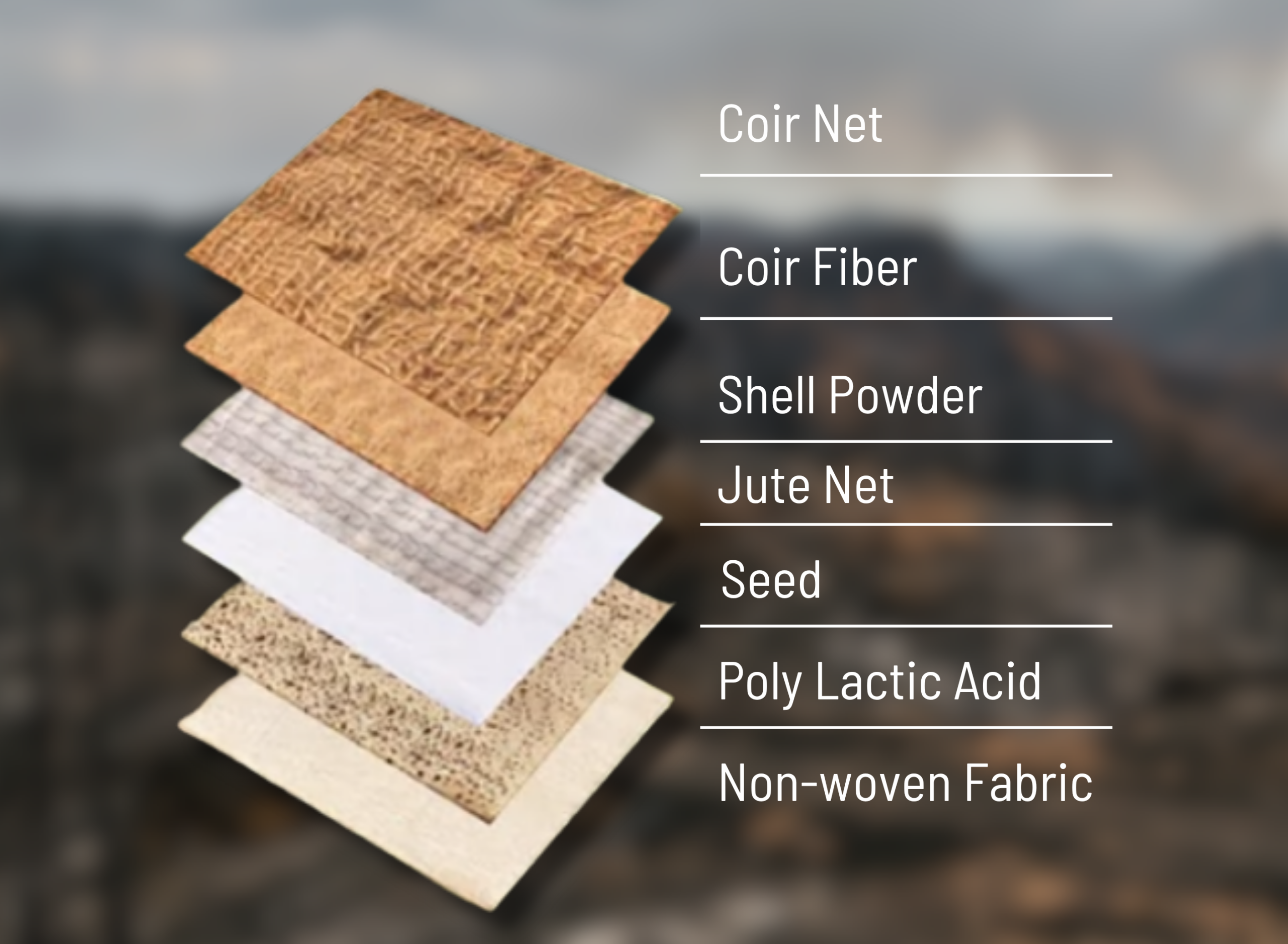
Vegetation Mat is designed with a multi-layered material structure, which helps prevent erosion from the early stages while supporting the restoration of natural ecosystems over time. Each layer in this structure plays a unique role, creating an effective and sustainable soil surface stabilization system.
- Coir net: Made from natural coconut husk fibers, this net layer has high durability and biodegradability, playing an important role in holding soil in place and effectively preventing erosion, especially on steep terrains.
- Coir fiber (in seashell powder): Finely ground coir fibers help reinforce the soil surface structure and enhance optimal water retention.
- Jute net: The natural fiber mesh from the jute plant increases load-bearing capacity, protecting slopes from direct erosion impacts of strong currents.
- In addition, the mat also uses fully biodegradable PLA non-woven fabric, which helps stabilize the soil surface in the initial stage and then transforms into organic matter, contributing to improving the natural soil ecosystem.
- Locally suitable seeds integrated into the mat: A carefully selected mixture of grass and flower seeds to match the specific soil and climate characteristics of each region. As they germinate through the PLA fabric layer, the native root system deeply anchors, naturally and most sustainably enhancing soil binding capacity.
Thanks to this multi-layered structure, the vegetation mat not only acts as an anti-erosion cover but also facilitates the development of a root system that naturally binds the soil. This is a crucial factor in helping slopes maintain long-term stability without relying entirely on traditional rigid revetment solutions.
4. Three main benefits of vegetation mats in limiting landslides and stabilizing slopes
Vegetation mat is not just an engineering cover, but a solution that simultaneously addresses multiple issues in erosion control and slope stabilization.
4.1 Increase soil stability through natural mechanisms.
Unlike rigid revetment solutions that only create an outer protective layer, vegetation mats help form a root system that binds soil from within. This contributes to long-term slope stability and reduces the risk of landslides during heavy rainfall or strong currents.
4.2 Reduce erosion risk from the early stages.
Immediately after installation, the mat layer acts as a barrier protecting the soil surface from the direct impact of rain and water flow. As a result, soil erosion is controlled from the outset, before the vegetation system fully develops.
4.3 Optimize costs and meet sustainable development standards.
Vegetation mats help reduce maintenance needs compared to traditional rigid revetment solutions. Once the ecosystem is stable, the role of the materials gradually diminishes and is replaced by natural root systems, thereby reducing long-term operating costs.
Notably, this solution has been certified as green technology by the Korean Government, affirming its environmental friendliness and applicability in sustainable infrastructure projects. This is a significant advantage for businesses and management agencies when needing to meet ESG standards and requirements from international capital sources.
5. Sustainable Solutions for Landslides and Slope Stabilization
Landslides and erosion are no longer potential risks but have become an actual problem in many areas, especially in riverside, coastal, and hilly terrains. Incidents in recent years show that relying solely on rigid revetment solutions or post-incident remediation is insufficient to ensure long-term stability.
In this context, the Vegetation Mat offers a different approach, combining engineering and biology to both control erosion from the outset and allow the ecosystem to self-recover over time. With its multi-layered material structure and adaptability to natural conditions, this solution not only helps protect the soil surface but also contributes to reducing maintenance costs and enhancing long-term effectiveness.
If you are looking for a sustainable solution to protect slopes and reduce landslide risks, vegetation mats may be a suitable approach to consider. Please contact Mekonglink for detailed consultation on the solution, site assessment, and proposal of an appropriate plan for the actual conditions of each project.
👉Or leave your information HERE, our team of experts will contact and support you as soon as possible.
—————-

☎️ Contact information:
1. Email: Community@mekonglink.asia
2. Website: mekonglink.asia
3. International Phone: (+84) 02888868685
4. Vietnam Phone: (+84) 364689922 (+84) 364689911


Responses